
Protect The Prophetic Voice of Your Church
Canada doesn’t need louder Christian outrage. Outrage is cheap. And outrage politics corrodes Christian witness.
Cousins, Not Clones
It’s impossible to ignore the gravitational pull of the United States on Canada’s political imagination. American media dominates our screens, our language, and increasingly our instincts. Over time, Canadians begin to speak in borrowed political accents. The saturation is not harmless.
When the Canadian church simply parrots American culture wars, our neighbours recognize it as foreign. Canada is not the United States. We are cousins, not clones.
When the church chooses partisanship over principle, it trades prophetic authority for short-term influence—and usually loses both. Jesus did not come to start a political party. He embodied a kingdom that refused the categories of his day.
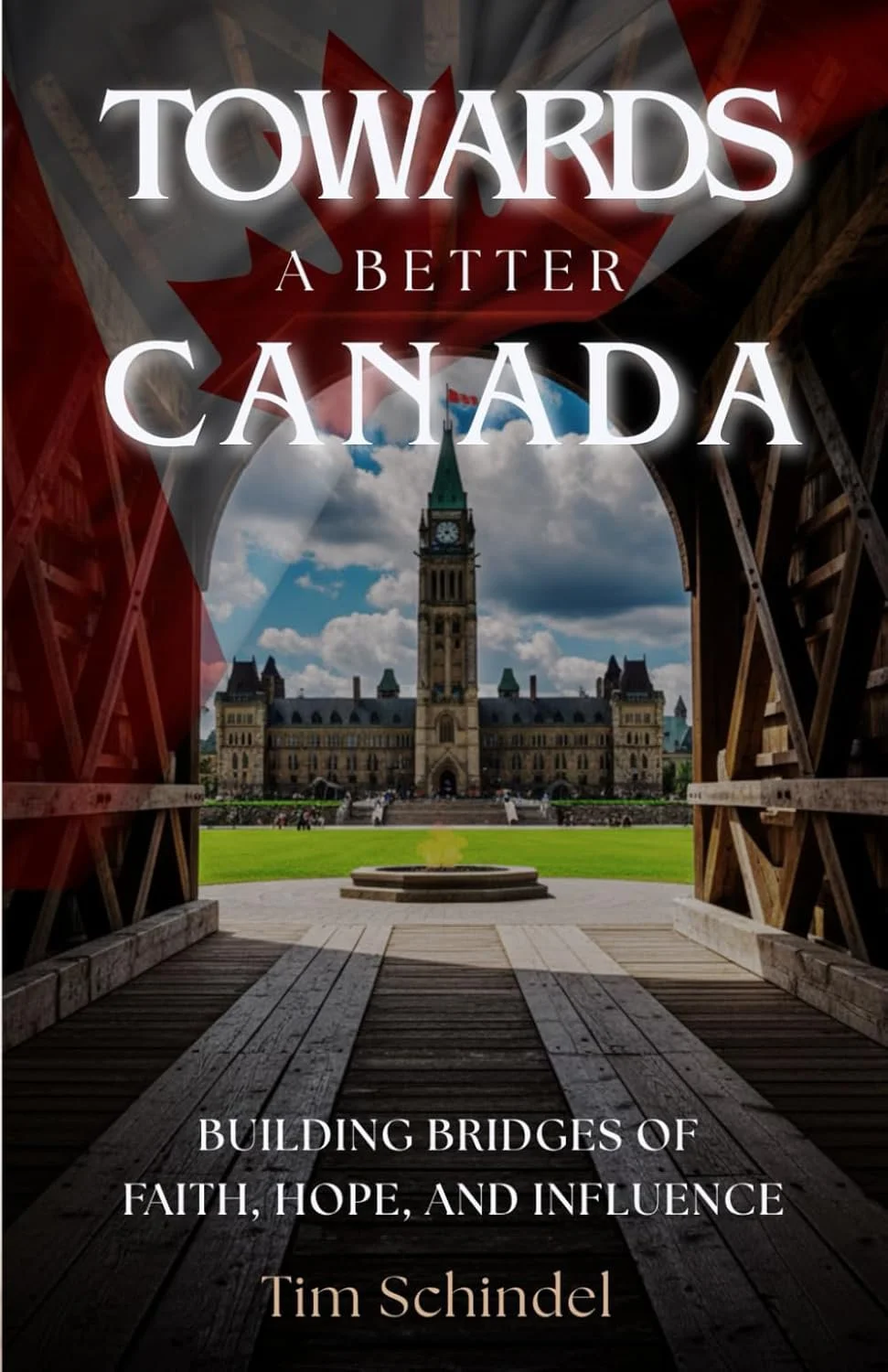
That conviction anchors Towards A Better Canada by Tim Schindel. Founder of Leading Influence, Schindel began ministry as an ordained pastor with the PAOC, and has spent the last two decades cultivating a quiet, non-partisan Christian presence among elected officials at every level of Canadian government. When he began, there were no chaplains for the government. Through patient relationships and principled presence, space was created—conversation by conversation—for Christian witness without coercion.
This book distills the convictions that have guided that work. The subtitle—Building Bridges of Faith, Hope, and Influence—is more than a metaphor. It’s mission.
Bridges As Lifelines
A bridge is not merely a structure. Schindel sees it as a lifeline.
A bridge connects what was once divided. It allows relationships, trust, and shared work to flourish. If the Church in Canada wants influence, it must recover the lost art of bridge-building.
Schindel roots this vision in Canadian history. He points to Sir George-Étienne Cartier, a French Catholic lawyer from Quebec and a Father of Confederation. In the turbulent years before 1867, tensions between English and French, Catholic and Protestant, Upper and Lower Canada were fierce. Many believed unity was impossible.
Cartier refused partisanship. Working alongside John A. Macdonald, he forged compromises that protected Quebec’s culture while casting a vision large enough to hold a divided nation together. Confederation was not born from outrage, but from imagination, restraint, and courage.
The Church in Canada is called to embody that same spirit: rooted in identity, generous in vision.
Changing Perception and Posture
Some of the sharpest critiques of Christians in Canada do not arise from hostility to Jesus, but from the perception that Christians care more about winning partisan battles than serving neighbours. That perception may not always be fair—but it is powerful. And perception shapes reality.
When faith becomes captive to partisanship, outrage follows close behind. If our hope rises and falls with election cycles, anger and despair will soon define our posture.
Canadian Christians have too often imported half-truths, apocalyptic tones, and social media tactics that simply do not translate in our context. Being ignored or dismissed is then misread as persecution. In truth, this approach undermines credibility and deepens division.
Canada doesn’t need a church defined by rallies, petitions, or online rage.
We can do better. We must do better.
Schindel calls us toward a distinctly Canadian Christian posture: humble, hopeful, peace-seeking, and relational. He invites the church to think in terms of cultivation rather than conquest, presence rather than pressure.
The church’s role is not to dictate Canada’s politics, but to shepherd imagination toward God’s heart—justice over expediency, mercy over law, humility over arrogance, reconciliation over suspicion.
A prophetic voice sees what is broken, names what is true, and calls people to a higher way. It blesses when others curse, steadies when others rage, and encourages when others despair.
Towards a Better Canada asks us to imagine churches known as trusted partners, not angry critics—and a Parliament or Legislature that experiences the church as a faithful presence, not a shouting voice from the sidelines.
That vision is not naïve. It is deeply Christian. And it may be exactly what our country needs now.
Two Steps To Take in 2026
Stop filling out online petitions. They are intended to make you feel like you are doing something. And it’s so easy. Smash one button, and you can advocate for change.
Start engaging with elected officials at every level of government. Your local council, MLA, MP. Sign up for their emails. See what they are focused on. Imagine if there were ways for you to be involved. Meet with them at their office. Ask what challenges they are facing. Pray for them in your regular church prayer times.
Quotes From Towards A Better Canada
“The incarnation, the word, becoming flesh and dwelling among us, is the model for Christian presence. Jesus did not shout from a distance. He moved into the neighbourhood. He listened, healed, taught and loved. His very being carried God’s presence into the world.”
“Prophetic blessing does not ignore injustice. It advocates for the poor and the marginalized but with humility, pointing always to God‘s heart.”
Purchase your copy of Towards A Better Canada.

Bob Jones is the founder of REVwords.com, an author, blogger, and coach with 39 years of pastoral experience. Bob is also an Advance Coach with the ABNWT Resource Centre. You can connect with Bob here.