
The Jethro Dividend: Why Leaders Need an Outside Eye to Shift from Operation to Unction
It is Tuesday morning, the worship team needs a schedule adjustment, the youth pastor is short two volunteers, the upcoming conference logistics are lagging, and you are trying to find three uninterrupted hours to study for Sunday’s message. You entered ministry to change lives through the power of the Holy Spirit, but right now, you are mostly changing fires.
This is the classic trap of the servant leader. Because we possess a passion to serve, we default into an intense operational mode—putting one foot in front of the other, focusing entirely on the immediate task ahead. However, when your eyes are locked onto the immediate horizon, you completely miss the panoramic view where the greatest opportunities for systemic, kingdom impact actually live.
If we are going to break the cycle of operational exhaustion, we need to talk about an ancient piece of ministry coaching found in the wilderness of Sinai.
The Sinai Boardroom: Moses and Jethro
In Exodus 18, we find Moses completely submerged in operational tasks. He is sitting from morning until evening judging disputes for millions of people. He designed the system, he loves the people, and he is a dedicated servant leader. But the system relies entirely on him. Enter Jethro, Moses’ father-in-law. Jethro wasn’t caught up in the daily grind of the Israelite camp. He brought an outsider’s set of eyes, a loving heart, a fresh perspective, and years of wisdom. He watched Moses and delivered a direct, candid piece of coaching: “What you are doing is not good. You and these people who come to you will only wear yourselves out. The work is too heavy for you; you cannot handle it alone” (Exodus 18:17-18, New International Version).
Jethro didn’t just diagnose the fatigue; he coached Moses toward a systemic solution. He instructed him to train capable, trustworthy leaders to handle the smaller, routine problems, leaving only the weightiest matters for Moses (Exodus 18:20-22). Jethro promised: “If you do this and God so commands, you will be able to stand the strain, and all these people will go home satisfied” (Exodus 18:23).
Moses trusted Jethro. He didn’t get defensive because he recognized that Jethro came with compassion, not competition. He accepted the coaching because he valued Jethro’s experience.
The Question Every Leader Must Ask
A respected personal mentor once dropped a piece of advice on me that completely shifted how I view my daily work:
“I delegate everything that I can. What is left—the things that only I can do—is where I spend most of my time.”
When we get bogged down in administrative or operational tasks that others could do, we have to ask ourselves the most confronting question in leadership: What am I not doing right now?
It is usually the things that only you can do—vision casting, deep spiritual preparation, strategic alignment, and mentoring the next generation—that get pushed off the ledger. Yet, it is precisely those non-delegable responsibilities that bear the largest, long-term, systemic fruit. What other people cannot do for you is exactly where your highest kingdom leverage resides.
By handing over smaller problems to a trained team, Moses freed up his capacity to handle the massive, strategic challenges that only he could address.
The Friction: Trust, Speed, and the Anointing
In ministry circles, we frequently blame our operational gridlock on external factors: a lack of volunteers, low budgets, or a lack of trained people. But if we are honest over a cup of coffee, the real bottleneck is often internal. It is a lack of trust.
We often think doing it ourselves is faster and protects the “anointing” or the quality of the ministry. Stephen M. R. Covey (2006), in his work The Speed of Trust, brilliantly dismantles this illusion. He explains that trust is a tangible economic driver:
“When trust goes down, speed will also go down, and costs will go up... Conversely, when trust goes up, speed will also go up and costs will go down” (p. 13).
When you refuse to delegate because you are worried someone might mishandle a task, you are paying a heavy “low-trust tax.” The ministry slows down, and the cost is paid in your personal fatigue and burnout.
John C. Maxwell (2011) echoes this in his law of empowerment, noting that true leadership growth requires a shift in mindset: “If you want to do a few small things right, do them yourself. If you want to do great things and make a big impact, learn to delegate” (p. 143). Great Pentecostal pioneers understood this. Smith Wigglesworth (2000) was famous for his radical, single-minded focus on faith and the ministry of the Word, leaving the administrative frameworks of his campaigns to trusted companions so he could focus entirely on what he was uniquely anointed to do. He famously noted that the Holy Spirit moves through order and faith, not through chaotic, overwhelmed strivings.
Shifting from Reaction to Renewal
How do we practically move out of the operational quicksand? It requires applying Stephen R. Covey’s (2004) classic framework from The 7 Habits of Highly Effective People: moving our lives out of Quadrant II (the urgent, reactionary fires) and into Quadrant I (the important, non-urgent strategic growth). Covey observed that “effective leadership is putting first things first. Effective management is discipline, carrying it out” (p. 148).
If you are experiencing fatigue, stress, or a sense that your ministry has hit a growth ceiling, you don’t necessarily have a volunteer problem—you might have a processing and coaching problem. You need an outside perspective to help you look past the immediate tasks and design a healthy, sustainable leadership ecosystem.
Take a cue from Moses. Find your Jethro. Invite a trusted mentor to look at your systems with fresh eyes. Step back, look at the bigger picture, train others, and protect your space to do what only you can do. That is where the lasting fruit is born.
From Principle to Practice: The Jethro Model in Action at Kingdom Advance
Theory only transforms an organization when it becomes practice. At Kingdom Advance, this shift from operational exhaustion to empowered delegation isn’t just a concept—it is a visible, intentional strategy built directly into our culture, particularly through our School of Ministry.
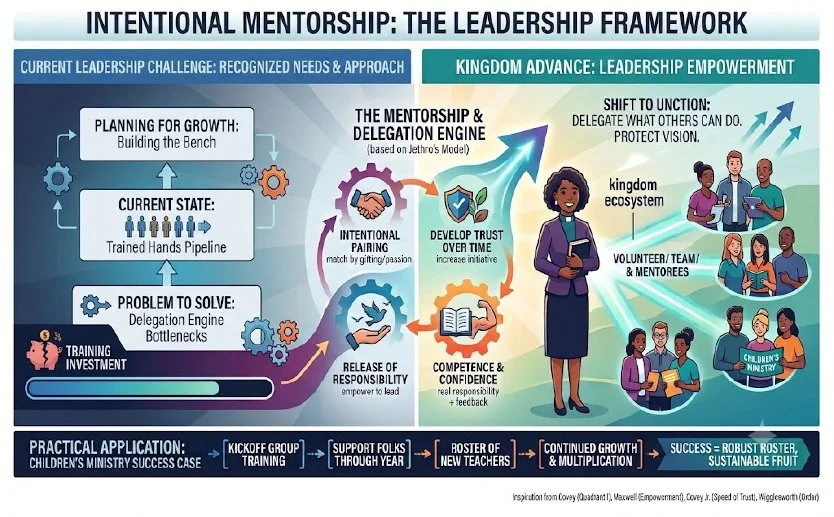
We recognize that stepping out of the operational quicksand requires a structured framework of mentorship: intentional pairing, competence building through real responsibility, and constructive feedback loops.
Case Study: Developing Sunday School Teachers
A clear example of this principle playing out in real-time is within our Children’s Ministry:
The Operational Bottleneck: The goal for the past year was simple yet vital—develop several new Sunday School teachers to build a healthy, sustainable roster for the upcoming year and avoid leader burnout.
The Strategic Intervention: Rather than carrying the entire teaching load operational-style, the year kicked off with group training, followed by ongoing, hands-on support throughout the season.
Building the “Speed of Trust”: As several volunteers showed real interest and took increasing initiative, trust was earned over time. With that trust established, greater responsibilities were progressively released to them.
Measuring Success: Success in this model isn’t just running a smooth Sunday morning once; it’s seeing last year’s volunteers step confidently onto this year’s roster with higher capacity, continuing their growth as fully empowered leaders.
The Takeaway for Leaders
When you invest time in training and mentoring others, you aren’t just filling a volunteer slot—you are paying down the “low-trust tax,” expanding your ministry’s capacity, and freeing yourself to focus on the strategic work only you can do.
By creating clear pathways where mentorees build both competence and confidence, you build a sustainable ecosystem where leaders thrive, and the kingdom advances.
Bibliography
Covey, S. M. R. (2006). The Speed of Trust: The one thing that changes everything. Free Press.
Covey, S. R. (2004). The 7 Habits of Highly Effective People: Powerful lessons in personal change(Rev. ed.). Free Press.
Maxwell, J. C. (2011). The 5 Levels of Leadership: Proven steps to maximize your potential. Center Street.
Wigglesworth, S. (2000). Smith Wigglesworth on Power to Serve. Whitaker House.
Christine is a purpose-driven and compassionate leader in education who believes lasting impact is built on trust, authentic connection, and empowered teams. She loves it when effective leaders multiply! With a people-first mindset, she champions initiatives that uplift students and families facing complex challenges across her region. For Christine, leadership is rooted in authenticity—showing up with clarity, courage, and care to bring people together around a meaningful vision. She thrives on creating spaces where individuals feel seen, supported, and inspired to grow. At her core, Christine finds her greatest fulfillment in helping others thrive—whether that’s the families she serves or the dedicated teams she leads.